Australian Horror One The Lost Soldier to an Empire of Bone and Ash Under the unsparing glare of a white-hot sky, the horror does not lurk in the shadows—it bakes into the earth's surface itself. This image presents Australian Gothic Horror as a visceral, speculative dread, where the landscape is not merely hostile, but an active, devouring force that refuses to let the past rot in peace. The horror is elemental and corporeal: human history grafted directly into ancient geology. The Lost Soldier's flesh has not decayed; it has calcified into red earth, oxidized stone, and petrified khaki cotton. It has accepted the intrusion of human technology—corroded copper telegraph wire coiled into sinew, thick glass insulators staring blindly like unblinking eyes—suggesting a brutal, botched metamorphosis. It has become the physical manifestation of an unspoken colonial and wartime trauma, where the forgotten dead are subsumed, weaponized, and regurgitated by the country they sought to ta...
Get link
Facebook
X
Pinterest
Email
Other Apps
Q
Get link
Facebook
X
Pinterest
Email
Other Apps
-
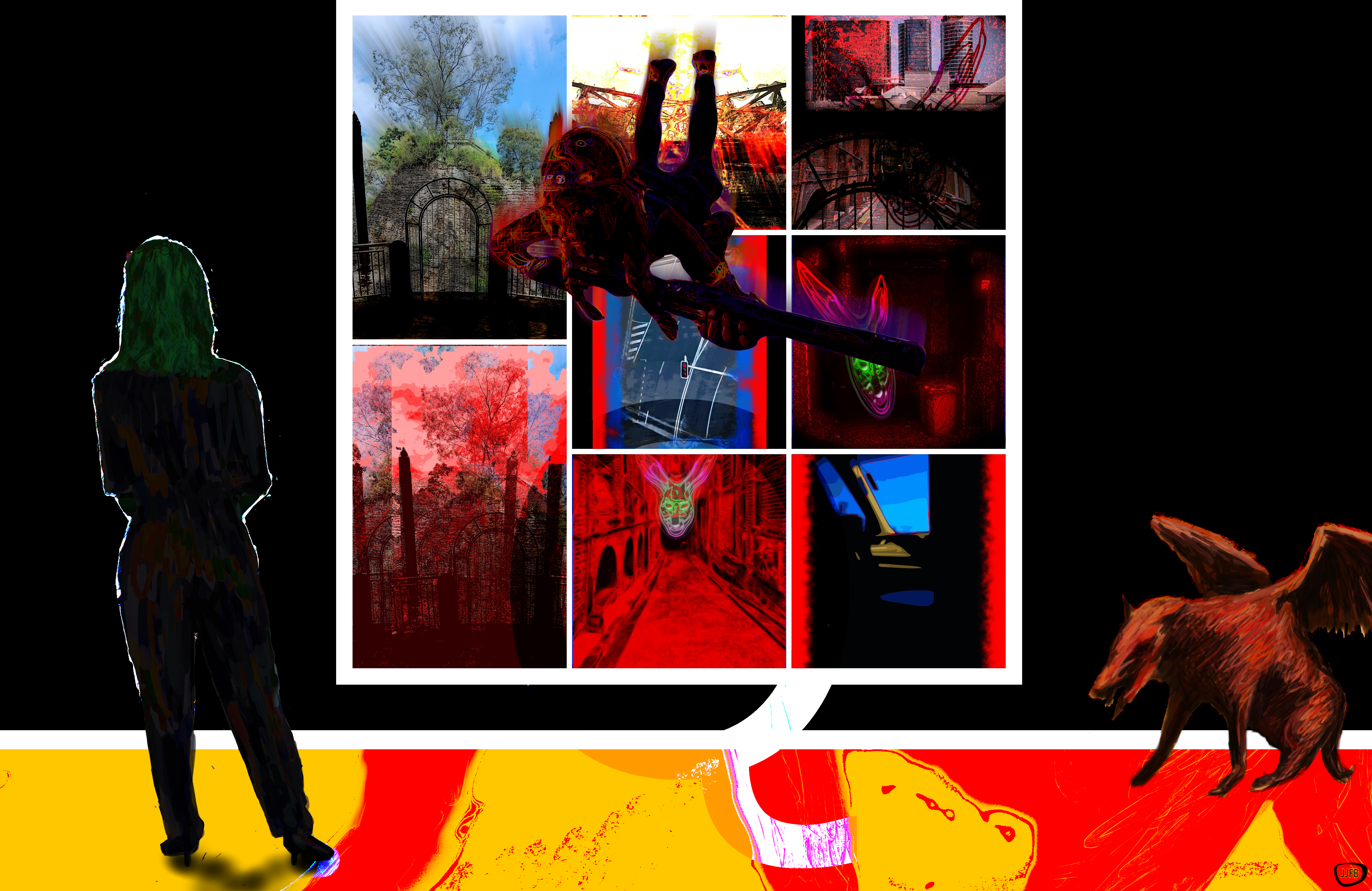
Q Gallery
Taking Action
The Arrival
Q Street Q STOP

Fortitude Valley Lane with Rabbit
Fortitude Valley End of Lane
The Flood Gate
The Red Flood Gate
Atonement on behalf of himself and all his kindred With pigtail
Sunrise over Story Bridge From God's own country to God's country
The High Rise and the Locked Gate
Rich Art Poor Art
Q
Q1
In 1859 Queen Victoria granted them their own colony
Q2
He returned with soldiers and established a temporary settlement
Q3
They were enticed by the promise of free land grants
Q4
The contributions made towards taming this land for the betterment of society.
Q5
And when the Americans arrived, they had the chocolates, the ice cream, the silk stockings and the dollars.
Q6
Our leaders demonstrated the actions of those who strive to abide by the biblical truths and to subjectively apply known half-truths.
The Highway and the Lost Soldier The midday sun around Adelaide River does something violent to the bitumen. At forty-five degrees, the Stuart Highway softens like melting fat; it turns into a black mirror, rippling with an unnatural, liquid glare that pools over every low rise. That is where it waits. He is always trudging south, away from life and deeper into the blistering furnace, his boots making no sound against the tar. The Highway and Lost Soldier Standing From two hundred yards out, he resembles a stranded traveler you’d pull over to save. He wears sun-bleached, disintegrating drill cotton that matches the bone-white dust of the termite country, his head angled down at an impossible, broken angle against the glare. No broad-brim hat. No swag. No water bottle. Just stiff, unnatural limbs jerking with every stride. “Driver... look at his face. We need to stop—why won't he turn around?” He is no lost tourist. Could he be the linesman from the Overland Telegraph days who tore ...
The Terminal Horizon Tourist Bus Discovering the Terminal Horizon The Long Highway Out here, the world ends not in silence, but in fire. The asphalt bleeds into cracked red earth, stretching toward a bruised horizon where the sky refuses to cool. Behind the glass, you drive chasing ghosts through a desert that forgot rain a lifetime ago. Beneath the Scorch Every road leads deeper into the furnace. Even below the surface, the rock fissures and weeps, hot steam rising through subterranean fractures where molten veins pulse in the dark, feeding an ancient, unforgiving heat. Broken Arteries What we built couldn’t hold. Rails twist into the dunes, swallowed by iron sand and wind. Bridges split down the seam, concrete splintered into raw bone, tangled rebar, and dying wires crackling into the smoke. The machines stopped; the wasteland stayed. The Last Horizon And when the road finally runs out, there is only the ash, the petrified stumps, and the quiet. You are a lone figure sitting in...
Incandescent - Ode to the Endless Scrub Beneath the vault of fallen light Where red dirt cools to iron stone The ancient country meets the night Unyielding, patient, and alone Cracked earth yields to twisted root To hardy bark and spinifex Where time leaves neither mark nor foot Nor petty boundaries to perplex Rank upon rank the pale trunks rise A silent host that drinks the dry Repetition stretching past the eyes To where the flat horizon lies Trees behind trees in quiet grace A labyrinth of slender wood Carving the stillness out of space Where centuries have stood Above, the sky ignites its coal A canopy of smoke and ember Holding the continent’s deep soul In dark and fiery surrender No hurried end, no measured shore Just red loam, shadow, branch, and tree The scrub that breathes forevermore Into the quiet of infinity. Be Creative and Innovative with Knowledge John Bennett - AKA JJFBbennett , is an independent artist. You can view and subscribe to my work via Blogge...







Comments
Post a Comment